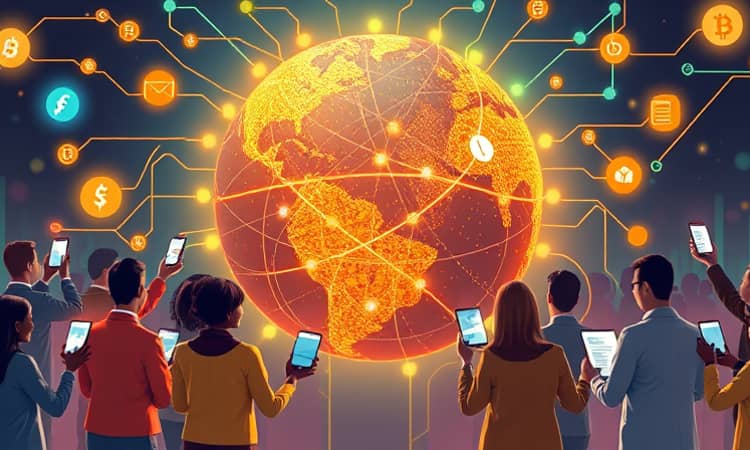
Over the past decade, lending has evolved from local bank branches to a dynamic, interconnected network of digital platforms and private credit providers. Today, individuals and businesses alike tap into a global financial ecosystem that transcends borders and financial institutions.
By leveraging technology, alternative lenders, and innovative credit models, borrowers can access capital faster than ever. This article explores the multi-faceted nature of modern lending, its transformative effects on economies, and practical insights for stakeholders seeking to thrive in this landscape.
Revolutionizing Finance Through Digital Innovation
In 2025, the global digital lending market was valued at $507.27 billion, set to expand to $566.52 billion in 2026 and reach $985.03 billion by 2031. This market’s projected growth underscores how fintech and mobile solutions are reshaping credit access.
Mobile devices are at the heart of this revolution. With over 7.4 billion smartphone users worldwide in 2026, a shift to mobile-first lending is enabling instant loan applications, real-time verification, and seamless disbursements even in remote regions.
Buy Now, Pay Later (BNPL) services exemplify this trend: in 2023, six major U.S. providers issued 335.8 million loans totaling $45.2 billion, funding 28% of unsecured debt for 18–24-year-olds. Such models illustrate how faster application and verification processes drive consumer engagement and financial inclusion.
- Growth Drivers: streamlined digital workflows, AI-based credit scoring, and expanding mobile wallets.
- Challenges: data privacy concerns, evolving regulatory frameworks, and robust risk management requirements.
Mapping Regional Disparities and Opportunities
Digital lending penetration varies widely across regions, influenced by technological infrastructure, regulatory environments, and consumer behavior. The table below outlines key metrics for 2025–2026.
These disparities highlight how regulatory reforms and fintech partnerships can unlock new markets. Emerging economies, in particular, stand to benefit from unprecedented private credit boom as non-bank institutions step in.
The Private Credit Surge and Non-Bank Lenders
Since the global financial crisis, private credit has surged. U.S. non-bank financial institutions (NDFIs) now account for over $1.1 trillion in outstanding bank loans, up from 6% of total lending in 2021. Globally, private credit reached $3 trillion in 2025, a 50% increase from 2020.
Europe also set records: €65 billion raised in the first nine months of 2025, with two mega-funds exceeding €10 billion each. This growth reflects a post-GFC de-risking by commercial banks and a hunger for higher yield products.
- Speed of execution compared to traditional banks eased by leaner processes.
- Diversification of portfolios with semi-liquid and NAV-backed strategies.
- Flexible structures tailored to middle-market companies and take-private transactions.
These developments offer SMEs and growing enterprises alternative capital sources, fostering resilient economic foundations that support expansion and innovation.
Banking Outlook and Economic Resilience for 2026
Major global banks maintain stable ratings, with 85% forecasted to keep consistent outlooks as of late 2025. Nevertheless, credit losses are projected to climb by 7.5% to $655 billion in 2026 before easing to a 4.3% increase in 2027.
Lower policy rates have reduced debt-servicing costs, cushioning asset quality despite muted growth. Meanwhile, rising demand for housing and AI-related financing suggests credit uptake will accelerate.
- Yields on leveraged loans expected to widen: 57% anticipate increases.
- Defaults forecast to rise: 77% foresee higher workout activity.
- Economic growth concerns: 40% expect stagnant or negative GDP impact.
Competition from private credit and fintech platforms will drive traditional banks to innovate, enhancing customer experience and streamlining operations.
Risks, Challenges, and Future Pathways
Despite strong fundamentals, several risks warrant attention. Geopolitical tensions, policy volatility, and fraud vulnerabilities could strain liquidity and undermine trust. Regulators worldwide are balancing consumer protection with innovation support.
To navigate these uncertainties, lenders and policymakers should focus on:
- Strengthening data security and fraud prevention frameworks.
- Harmonizing cross-border regulatory standards.
- Promoting financial literacy and responsible borrowing.
By prioritizing stability and inclusion, the lending industry can capitalize on technological advances to serve underserved communities and support global development.
Conclusion: Embracing a Connected Financial Future
The evolution of lending from brick-and-mortar banks to a borderless, digital ecosystem has unlocked unprecedented opportunities for individuals and businesses. As fintech innovations and private credit expansion continue, stakeholders must collaborate to manage risks and ensure sustainable growth.
By embracing global connectivity and progress, lenders can extend financial access to new markets, empowering entrepreneurs, fostering economic resilience, and driving inclusive prosperity across the world.