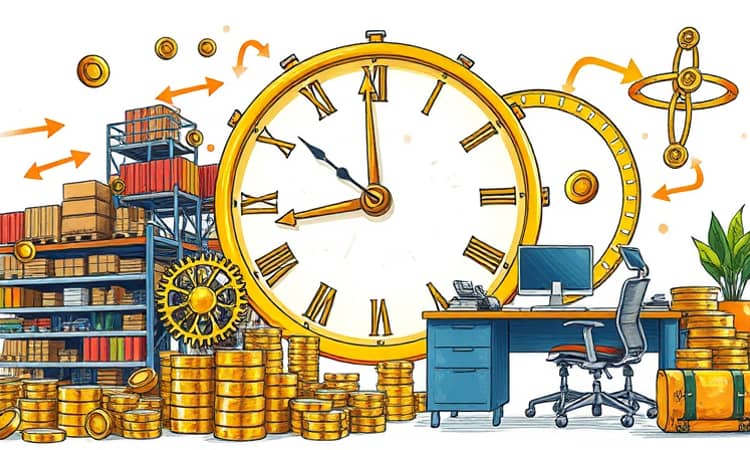
In today’s fast-paced economy, every moment of operational time represents a potential dollar. Yet many businesses allow these opportunities to slip away, trapped in inventory, unpaid invoices, or slow supplier payments. The Cash Conversion Cycle (CCC) offers a framework to unlock this hidden value, showing how companies can transform time into cash and drive sustainable growth.
Understanding the Cash Conversion Cycle
The Cash Conversion Cycle measures the number of days a company’s cash is tied up in its operating cycle. Calculated as CCC = DIO + DSO – DPO, it balances three key components:
- Days Inventory Outstanding (DIO): How long inventory sits before sale.
- Days Sales Outstanding (DSO): The time taken to collect customer payments.
- Days Payable Outstanding (DPO): The period a company takes to pay its suppliers.
A lower or negative CCC means cash inflows precede outflows, freeing up capital for reinvestment. Amazon, for instance, achieves a negative cycle by collecting payment instantly while paying suppliers 60–90 days later, effectively using supplier credit as working capital.
Why CCC Matters for Business Health
Beyond simply tracking days, the CCC serves as a powerful liquidity gauge and efficiency metric. Investors scrutinize it to assess a firm’s operational prowess and risk profile. For retailers and manufacturers, where inventory and receivables can balloon, optimizing CCC can spell the difference between thriving and overleveraged.
Consider a business with a 66.5-day cycle: cash is tied up for more than two months before it returns. During that time, suppliers expect payment, payroll is due, and new inventory must be sourced. Reducing even a week from this period can unlock thousands in freed-up cash, enabling expansion without additional borrowing.
Case Study: Cash Converters’ Three-in-One Model
Cash Converters exemplifies how mastering turnover and lending creates resilience. Operating under one roof, it combines:
- Buy/Sell Retail: Customers trade pre-owned goods for instant cash; items are resold at a profit with a six-month guarantee.
- Secured Lending: Short-term loans against collateral, which are sold if borrowers default.
- Unsecured Advances: Payday loans repaid via debit order, targeting sub-prime customers.
This diversified model generated $112.2 million in retail sales and $38.6 million from personal finance in FY2021. By cycling products and credit, the franchise converts customer assets and expectations into multiple revenue streams, demonstrating recession resilience and robust cash flows.
Strategies to Optimize Your CCC
Reducing the cycle requires a balanced approach that speeds up cash inflows while delaying outflows—always within ethical and legal boundaries. Key strategies include:
- Accelerate Inventory Turnover: Implement just-in-time ordering, promote fast-moving products with discounts or bundles, and regularly clear slow sellers.
- Streamline Collections: Use electronic invoicing, offer early-payment discounts, and set clear credit policies to reduce Days Sales Outstanding.
- Extend Payable Terms: Negotiate longer payment windows with suppliers, leveraging volume commitments or early payment flexibility.
Automation tools can amplify these efforts. Platforms like Ramp use AI to extract invoice data, schedule payments for maximum benefit, and deliver real-time analytics. BILL automates invoicing and payments, enabling ACH or card transactions that both accelerate receivables and extend payables.
Real-World Scenario Benchmarks
This table highlights the stark contrast between a cash drain and a cash fountain. Moving from a +66.5-day cycle to a -10-day cycle transforms capital requirements and opens doors for reinvestment.
Practical Steps to Implement Today
Transforming your CCC demands deliberate action and continuous monitoring. Start with these practical steps:
- Conduct a Cash Flow Audit: Map your current DIO, DSO, and DPO values to identify bottlenecks.
- Negotiate Supplier Terms: Propose extended payment plans in exchange for higher purchase volumes.
- Invest in Automation: Adopt AI-driven platforms for AP/AR to reduce manual errors and delays.
- Monitor Daily Metrics: Use dashboards to track cycle changes and respond quickly to deviations.
Remember, CCC optimization is not a one-off project; it’s a mindset. Embed efficiency goals into your team’s objectives, reward improvements, and treat time savings as a competitive advantage.
Conclusion: Your Time Is Truly Money
Every day that cash sits idle, your business pays a hidden cost. By mastering the Cash Conversion Cycle, you convert operating days into a dynamic source of funding, fueling growth and stability. Whether you operate a retail chain, manufacture goods, or manage service contracts, reducing DIO and DSO while extending DPO can liberate capital for innovation, marketing, or talent acquisition.
Embrace the Cash Converter mindset—measure diligently, automate strategically, and negotiate wisely. In doing so, you’ll not only accelerate cash flow but also cultivate a culture that values time as the ultimate currency. Start today, and watch how turning time into money becomes your greatest competitive edge.