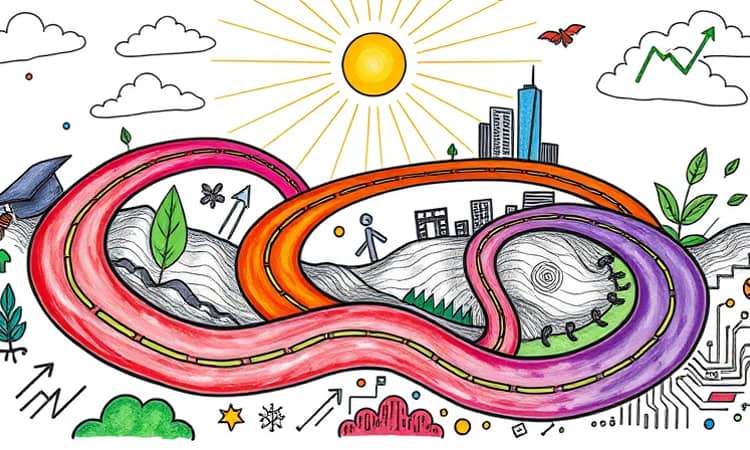
In a complex world where opportunity and challenge intertwine, charting your own course can feel overwhelming. Prosperity Pathways invites you to envision structured routes to personal, community, and economic wealth that blend education, investment, and well-being. From youth career bridges to county-level dynamics, and from smart budgeting to emerging fintech innovations, a coherent roadmap can transform ambition into lasting success.
Charting Your Personal Prosperity Pathway
Every journey begins with a clear destination—and for many, that means attaining financial security and meaningful work. Young adults transitioning from education to a family-sustaining job benefit from frameworks like JFF’s Pathways to Prosperity. This model relies on five critical levers, including secondary-postsecondary integration and employer talent pipelines, to ensure students graduate ready for today’s economy.
Beyond formal credentials, individuals can accelerate wealth building through diversified strategies. Whether it’s harnessing the power of compound interest in stock portfolios or leveraging fractional real estate to hedge inflation, thoughtful choices lay the groundwork for a resilient financial future.
Building Blocks of Community-Wide Prosperity
Prosperity is more than a personal milestone—it emerges from collective progress. Sequence analysis of county well-being scores from 1990 to 2020 has identified over 300 unique patterns, revealing trajectories of growth, decline, or stability. Such insights underscore the importance of sequence analysis of county well-being scores in crafting targeted policy, rather than one-size-fits-all interventions.
Economic theory reminds us that capital accumulation, labor force growth, and productivity are the pillars of long-run prosperity. When regional institutions, climate, or geography present challenges, coordinated efforts—such as state-led investment initiatives or public–private partnerships—can tip the balance toward shared success.
Wealth-Building Strategies for 2026 and Beyond
In an era defined by rapid innovation and global uncertainty, a comprehensive toolkit is vital. Below is an overview of effective strategies organized by category, helping you tailor your approach to changing market conditions.
Emerging Trends Shaping the Future of Wealth
- Tech-Driven Planning and Advice: AI-powered financial assistants deliver personalized, data-driven roadmaps, from tax-optimized portfolios to spending alerts.
- Alternative Investment Growth: Private credit, fractional real estate, and real-asset funds diversify beyond traditional stocks and bonds.
- Sustainable and ESG Investing: Consumers demand corporate accountability, driving inflows into green energy, social bonds, and values-aligned enterprises.
- Dynamic Risk Management: Month-by-month goal setting, scenario planning for downturns, and readiness for M&A or macroeconomic shifts.
Policy Imperatives and Collective Action
Communities thrive when policy design reflects localized realities. Prosperity Pathways research highlights the uneven patterns of growth and decline, advocating for bottom-up strategies that harness local assets. Education systems can close skill gaps through employer-educator-government collaboration, while infrastructure investments should prioritize inclusive access.
Broader economic frameworks, such as the Hamilton Project, remind us that free markets perform best when balanced with government support for broad participation and safety nets. By redefining prosperity to include well-being metrics, policymakers and citizens can co-create resilient economies that serve everyone.
Charting a Roadmap for Action
As you embark on your own Prosperity Pathway, start by mapping current resources and setting measurable goals. Use budgeting tools to track progress, schedule regular reviews of asset allocation, and engage with community initiatives that foster collective uplift. Remember, wealth encompasses more than financial gain—it includes health, education, and social capital.
Embedding sustainable and values-aligned wealth practices ensures that success benefits both individuals and the wider society. Whether you’re a student exploring career routes, a household building net worth, or a policymaker designing regional strategies, the principles of pathway thinking provide a powerful compass for transformative change.
Looking Forward
The journey toward long-term prosperity is ongoing, shaped by technological innovation, social movements, and economic cycles. By embracing a pathway mindset—one that views wealth as a dynamic process of growth, adaptation, and collective engagement—you position yourself to thrive amid uncertainty.
With actionable insights for sustainable growth and impact, and a commitment to learning and collaboration, your roadmap to riches becomes more than a dream: it becomes a reality you can share with your community and future generations.