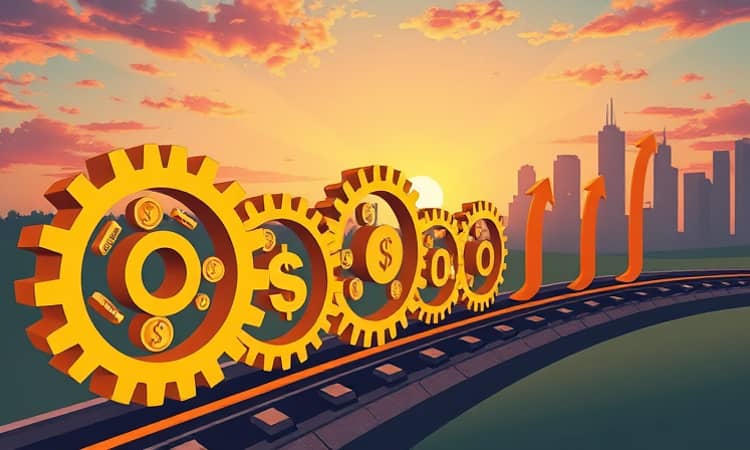
In today’s ever-shifting economic landscape, mastering the art of financial leverage tools like gearing can turbocharge your journey toward lasting prosperity. By viewing debt, investments, and strategic planning as interconnected gears, you can fine-tune each component for maximum impact.
Understanding Growth Gears: Financial Leverage Tools
The Growth Gears concept offers a metaphor for harnessing borrowed capital, diversified assets, and compounding returns to accelerate wealth building speed. Just as mechanical gears multiply force, systematic process of increasing assets relies on alignment between income, savings, and risk control.
We define two main phases in your wealth journey. The accumulation stage, often in your 30s and 40s, focuses on aggressive saving and strategic investing. Later, you shift to preservation, safeguarding gains and ensuring sustainable income through retirement.
Gearing Strategies: Primary Gear for Acceleration
Gearing means borrowing to invest. When done with discipline, it magnifies gains, though it also increases exposure. Two core types illustrate this balance:
To engage gearing effectively, keep these conditions in mind:
- Stable income and a long-term capital growth support horizon (10+ years)
- Suitable assets, such as equities, managed funds, or growth-focused property
- risk-adjusted debt management strategies like LVR limits, diversification, debt reduction targets and insurance
Top Wealth Building Strategies for 2026
Emerging trends for 2026 emphasize balance between innovation and resilience. Key vehicles include retirement accounts, ETFs, real estate, and digital assets. Each offers unique tax and compounding advantages.
- Max out 401(k)s, IRAs, or local equivalents for time's exponential power in compounding
- Diversify across stocks, bonds, real estate, commodities, and crypto
- Develop side businesses or digital products to transition active income into passive streams
Diversification & Allocation
A thoughtfully spread portfolio cushions volatility. Aim to rebalance quarterly, mixing large- and small-cap equities, fixed income, and real estate. Consider ESG or socially responsible funds for broader impact.
- Allocate according to risk tolerance and life stage
- Use inflation hedges, such as TIPS, commodities, or property
- Establish an emergency fund for downturn resilience
Risk Management & Resilience
Any geared approach requires robust defenses. Volatile markets, inflation spikes, or personal income changes can strain positions. Build buffers to keep your gears turning smoothly.
First, set aside three to six months of living expenses in liquid assets. Second, review insurance protections—life, income, and property policies—to safeguard collateral and cash flow. Finally, determine stop-loss levels or hedging strategies to lock in gains while limiting drawdowns.
2026-Specific Trends & Priorities
As we move through 2026, technology will reshape investment access. AI-driven advisors, blockchain-based asset tokens, and fintech platforms lower barriers to entry. Meanwhile, evolving tax regimes and geopolitical shifts demand regular plan reviews, especially if career or family circumstances change.
Multi-generational planning also gains prominence. Early estate arrangements and tax-smart inheritance designs ensure that growth gears pass seamlessly to the next generation, maximizing compound and legacy effects.
Numerical Examples & Benchmarks
Consider £1,000 invested at 5% annual compounding: after one year, it becomes £1,050; after two years, £1,102.50. Such steady growth, repeated over decades, transforms modest sums into significant portfolios.
Milestone benchmarks often serve as motivators: consistently saving and investing might see you reach $1M in your accumulation phase, $5M mid-career, and $10M+ approaching financial independence. At a 30% annual return on a $5M portfolio, you’d generate $1.5M in gains that year.
Integrating Gears into a Broader Financial Plan
A holistic plan weaves gearing into a larger framework: set clear goals, select assets that reflect those objectives, define risk parameters, and schedule regular reviews. Adapt your approach as you move from accumulation to preservation, using tax data and income projections to refine strategies.
By aligning each gear—debt, investments, insurance, savings—you create a synchronized system that propels you forward. Thoughtful coordination maximizes leverage while keeping risks in check.
Conclusion
Growth Gears offer a powerful lens through which to view wealth accumulation. By consciously applying diverse investment mix for resilience, strategic borrowing, and disciplined risk controls, you can multiply the impact of every dollar invested. Remember: the earlier you engage, the more pronounced time's exponential power in compounding becomes. Begin aligning your gears today, and accelerate confidently toward the financial freedom you envision.